Iran War - Moving to Ground Troops


Email: decodingpolitics@protonmail.com
Substack: decodingpolitics.substack.com
Twitter: twitter.com/DecodingPoliti2
*Not financial advice, merely pointing out political and macro trends*
The Iran War has gone on for two weeks at this point. It has been aerial and ballistic missile exchanges thus far. A key announcement leads us to believe it will now shift into a new more serious, phase involving US ground troops in Iran.
The US has announced it will shift up to 5,000 Marines from Japan to the Middle East. Not just any troops: It’s a Marine Expeditionary Unit, one of the first on the battlefield in any conflict, specialized in amphibious landings. Those troops, coupled with troops already deployed in the region and America’s Rapid Deployment forces, will soon give the US a pool of 15,000-20,000 troops to draw on for an invasion. Those troops combined with US air superiority will allow the US to seize two key assets and then attempt to force an Iranian surrender or cease fire, and keep the oil markets under control.
We have called this war to a tee thus far, probably the only publication in the world that can make that claim. It’s proving to be more difficult than the US government or pundits thought, but in line with what we expected. Now it shifts to the next phase. We will keep you posted every few days so you can safely wade through the disastrously wrong analysis of Wall Street and the legacy media.
We estimate the ground troops enter Iran about three weeks from now. Best guess on timing is right around the Trump-Xi summit of March 31 to April 2nd. Between now and then investors may adjust to the slower pace of the air war and grow complacent. But they will get shaken anew when troops show up in Iran.
1. The Conflict Reality Versus Expectations
2. TACOs For Dinner?
3. The Next Targets
4. A Look at US Military Assets
5. The Likely Outcome
1) The Conflict Reality Versus Expectations
We wrote in our January 25th piece Get Ready – War in Iran Coming Soon the base case of what we expected to unfold:
· A US/Isareli attack aimed at regime change and crippling Iran’s military and nuclear program
· A multi-week strike that could stretch into multi-month
· There were no real negotiations on the table as an off-ramp
· An asymmetric response by Iran, with regional drone strikes and the closing of the Straits of Hormuz
· Timing we anticipated between February 15th and March 31st-. It began February 27th
Most people thought we were crazy, or we were channeling John Bolton’s fantasies. Unfortunately, all of our expectations have proven to be the case.
Two weeks into the conflict, it’s clear that the quick decapitation strike and regime change playbook of Venezuela does not apply here. The continued Iranian response and the strangling of the Straits of Hormuz have taken many in the government and media by surprise. Repeated calls from many that ‘Trump will TACO’ flew in the face of the Administration and military’s own statements and have been wrong.
This war is proving to be far more serious than Washington initially thought and the lack of preparedness is obvious to everyone. The global economy is hanging on a knife’s edge with the Straits of Hormuz shut and Iran attacking ships. The regime has merely rotated leaders and the IRGC remains fully in command. Iran has attacked targets in multiple countries and continues to hit them.
This conflict was not resolved by air alone. We said earlier emphatically that there will be no mass ground invasion and occupation- the US lacks the military and political will to do such an operation. The Iraq war involved 250,000 soldiers. Fully invading Iran fully would require at least 500,000 troops. It won’t happen.
Yet the US will have to adopt a limited ground presence now to force an Iranian surrender. We had earlier expected select raids and operations against the nuclear plants. Now it looks like the US will use 15,000-30,000 ground troops to occupy key sights in the South of Iran to weaken the regime and to reopen global trade. They initially thought they wouldn’t be necessary and were only a contingency plan. Now that contingency is being activated.
Is there really no chance of a deal? Where would ground troops target? Who would do the fighting and when? How will this all resolve itself?
2) TACOs For Dinner?
During nearly all of his first and second terms, Trump would initiate negotiations with bold targets or threats. He would continue piling on against the target nation. Then at the last minute, he would pull back and settle on a deal. The market got so used to this pattern it adopted the acronym TACO to describe it: Trump Always Chickens Out. The market has expected the same thing in Iran since the second day of combat.
We think they are sorely mistaken. Trump has used that strategy in trade negotiations because it worked. But this is a military operation with defined objectives: Regime change, an end to the nuclear program, an end to the ballistics program. Negotiations did not lead to this path, so force was chosen.
For the time being, there is no chance of a TACO. There is no clear leader to talk to, the two sides are miles apart, and the US thinks that the longer the operation goes on the more leverage it has.
The killing of Ayatollah Khamenei forced the election of a new Supreme Leader. His son, Mojtaba Khamenei, was chosen. But news reports indicate that he is laid up in the hospital, missing a leg, or in a coma, or not conscious of current events. His national address merely had a photo of himself and someone else reading the speech. The rumor is he is a figurehead. With no clear national leader, and a bunch of IRGC leaders bent on revenge running the country, there’s no one to talk to.
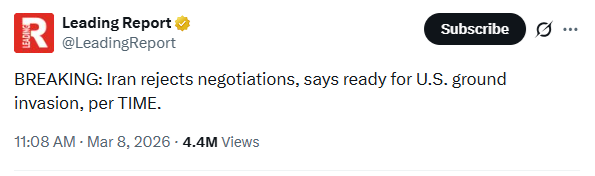
Iran’s Foreign Ministry released its demands for a ceasefire, which it has to know will go nowhere in DC:
“Iranian President Masoud Pezeshkian has outlined three non-negotiable conditions for a ceasefire: recognition of Iran’s “legitimate rights,” reparations for war damages, and binding international guarantees against future US or Israeli aggression.” – MSN
The US for its part is demanding regime change and unconditional surrender now. This is on top of demands to end the nuclear and ballistic programs, and to withdraw Iranian support from around the region. Again, these have been and remain non-starters for Tehran.
With no clear Iranian leadership and a bid/ask spread for negotiations that is a mile wide, there’s nothing for Trump to TACO to at the moment.
3) The Next Targets
At this point in the conflict, the US will have to continue its air campaign. It will keep looking for launch sites of Iranian missiles. It will keep looking for the uranium, now reportedly miles underground. And it will keep hitting IRGC assets wherever they find them.
Two key targets are outstanding however to defang the Iranian military threat to the Gulf and Israel and to reopen global trade. We have circled them on the map. The black circle is the military base of Bushehr and the nearby oil terminal of Kharj (aka Kharg) Island. The red circle is Bandar Abbas, the small city on the Straits of Hormu and the nearby island of Qeshm.
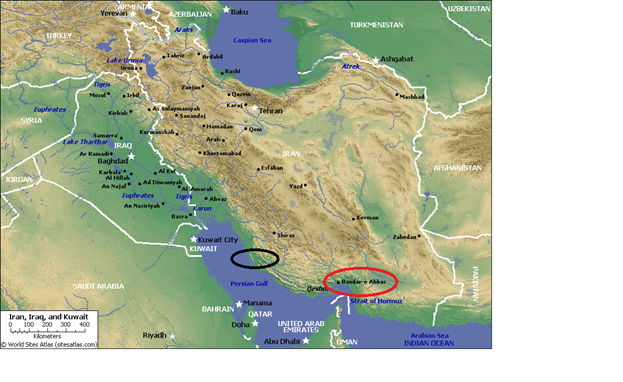
Why these two? Bandar Abbas is the city and base that is opposite the Straits of Hormuz. Controlling this area and the bases nearby is necessary for disabling surface attacks and reopening global trade.
Kharj Island is the home of Iran’s oil export industry. It’s the terminal with room for the biggest oil tankers (VLCC) and has pipelines running to it from around the country. Taking out this facility would cripple Iran’s oil exports and kneecap the regime financially. The US military claimed on March 13th that it had bombed and taken out all of the military targets on the island. This is part of the way of clearing the path for a takeover. It is further up the Persian Gulf so it will take time to clear all the threats in the several hundred miles around it.
Iran has many shore to ship missiles and even underwater drones. The US military has written extensively on the capabilities of these:
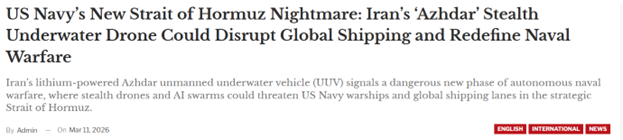
- Defense Security Asia
The military will focus extensively in the next two weeks in clearing the Iranian abilities to strike ships and strike troops in the Gulf. The missiles further North in Iran are ballistic and targeted at Israel and other targets. They are not useful in taking out the US naval abilities.
Iran also has a huge food security problem. It imports massive amounts of basic cereals, many from European countries like the Netherlands, Denmark and Switzerland. But Brazil is 10% too. The US could blockade or threaten to blockade those imports and effectively starve the country out if things got serious in an occupation of Southern ports.
On another note, look at the incredible mountain ranges that ring the entire Southern coast of Iran. These massive ranges will effectively block any US invasion from attacking the major population sources of the North like Tehran, Isfahan and Tabriz.
4) A Look At US Military Assets
The US has been relying on its naval and air force assets thus far to hit regime targets. But the signs are already emerging of a shift to ground troops. It would be almost exclusively US troops, as Israel’s forces to deploy outside its borders are very limited. The US is transferring 5,000 Marines from Japan to the Middle East:
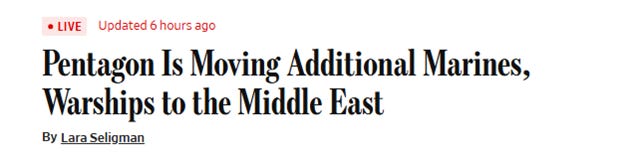
-WSJ
Significantly, this is a Marine Expeditionary Unit. These are one of the US military’s first on the battlefield units. They specialize in amphibious landings and often work with Special Forces. Summoning this unit means that the military is seriously moving in assets for a rapid, naval attack on a key location.
More from the head of the US Marines:
“Forward-deployed amphibious forces remain a uniquely critical and capable component of our national strategic demands for forward presence, crisis response, power projection and theater security cooperation. The Marine Expeditionary Unit (MEU) and associated Amphibious Ready Group (ARG) provide the Geographic Combatant Commanders with forward-deployed, sea-based, expeditionary forces that can operate across the range of military operations. Capable of enabling joint, interagency and coalition forces and seamlessly integrating with Special Operations Forces, no other type of force possesses these capabilities together with the ability to sustain itself logistically for significant periods of time.”
These units come with their own group of fighters and Osprey transport vehicles. They also have tanks, APCs and helicopters. They are in essence mobile mini-militaries that most importantly do not require an airway to operate from.
It will take 1-2 weeks for the unit to arrive to the region. We can realistically estimate any time frame involving this unit in action as two to three weeks from now.
But this is only one of the assets available to rapidly deploy. The US army maintains several units globally that can deploy almost anywhere within a day. They also maintain several units that quickly follow or lead major operations. The MEU’s are the Marine’s rapid reaction force, and often serve that purpose for the entire military.
The most important rapid response force is the paratrooper division, the famous 82nd Airborne. The military website says that the 82nd maintains a brigade (2,000 to 3,000 troops) that can deploy anywhere globally within 18 hours. That unit has been sent out several times in the past few years. On March 6th, a large upcoming training mission was canceled. Speculation is running that this is to give the unit the time to deploy to the Gulf and ultimately Iran.

- MSN, March 6th
The absence of a training exercise in March would allow the entire unit of 15,000 troops to deploy within a few days of being called up. Whether or not just a brigade or the entire unit is sent remains to be seen, but certainly the Pentagon has this as a viable option to quickly commit troops on the ground.
The US military has another airborne division, the 101st. That unit had been partially deployed the past three years in Romania in the case of operations in Ukraine. It was recently sent home however, and so is stationed back in Kentucky. It specializes in helicopter attacks and troop movements. The Centcom Citadel website says that they can operate at a range of up to 900km. That’s too short a distance for them to be deployed from Israel to hit Iran (1500km to Bushehr). They would have to be moved to a Gulf base to be used, which would make them vulnerable to drone and missile strikes. We see it as unlikely the 101st sees action in the first days.
Two other US divisions usually follow the 82nd in just a few days- the 4th Infantry and the 10th Mountain division. Watching for movements of these troops in the coming days will be key to determining the size and timing of a US strike.
Finally, we have the US special forces- Army Rangers, Navy SEALS, Delta Force, Green Berets. There is plenty of evidence that teams have moved into place in Israel, the Gulf, and Azerbaijan over the past weeks. Of course the US has not announced numbers and locations. But past tweets show several cargo planes loaded with Special Forces came in. And we can assume that more teams are with the US carrier battle groups. So we will guess that there are a couple of thousand troops available.
Let’s add it up. We have:
5,000 Marines available in two weeks
~3,000 82nd Airborne available overnight
~10,000 82nd Airborne in a week or two?
~1,000-2,000 Special Forces/Navy SEALs/Delta Force available within a week?
= Roughly 20,000 troops available to attack Iran soon
If other troops are brought in from US bases in Turkey, Germany, Italy, or from the US itself, in the next two weeks we could get to 30,000 troops ready to go for this operation.
5 ) Likely Outcomes
In our initial piece we listed three scenarios and their odds. Total American Victory (20%), Total American Defeat (30%), and Compromise (50%). Our view of potential compromise was this:
“We all know that Trump starts negotiations with a big ask, and will walk it back to a more realistic outcome. We think that the big ask here is regime change. But if several months of strikes had proved insufficient for regime change, he would settle.
What would such a settlement look like? More promises on the nuclear program. A withdrawal of Iranian forces and support from the region.
It will probably involve the Ayatollah remaining but Constitutional changes to allow more room for dissenting voices.
In return, Iran would get a roadmap to international recognition and sanctions relief.
Chances: 50%”
We still think that we on that path. A total American victory looks highly unlikely at this time. A total American defeat won’t happen either unless China rolls out new technology that destroys the US Navy. Regime change writ large, like a return of a Pahlavi led government, looks remote now. Far more likely is a shake up of the existing leadership. Trump’s big ask has been unconditional surrender and regime change, and he will begin to move to the middle on those two demands. We would move to a negotiated compromise.
We think a ground attack tying down the Iranian economy and the Iranian military forces such an outcome. If the US did such a move, it would be able to hamstring Iran’s key imports and exports, freezing the country. But it would be clear that the US would not have the ability and the political will to occupy the rest of the country.
An often overlooked but important fact is also that southern Iran is one of the hottest places in the world. Temperatures average 100F (38C) over the summer, and often cross 110F-115F (42C-45C). The US military would have very limited chances of success if they tried to extend their gains over the summer, with extreme heat hitting its soldiers and equipment hard.
The US would move from its posture of unconditional surrender towards a posture of a negotiated surrender/cease fire deal. Some faction within the clerics or the IRGC itself would begin to lay out reasonable terms for the US to withdraw and Iran to reduce its offensive military capabilities. We would guess that those talks start after an April ground attack, and would be finalized by June.
Both sides would declare victory and mission accomplished. But more realistically it’s just a reshuffling of who controls what in the power politics game.