January 2026 Monthly
Quick Hits: Iran, Brazil, Cuba, Venezuela, The Fed

Email: decodingpolitics@protonmail.com
Substack: decodingpolitics.substack.com
Twitter: twitter.com/DecodingPoliti2
*Not financial advice, merely pointing out political and macro trends*
After a very eventful January, we are going to a monthly piece that is just a bunch of quick hits on topics we have gone into in more detail in other places.
Iran looks headed for a US blockade in the next week. This would be the prelude to more sustained bombing and naval strikes. There are no talks ongoing, and Trump’s proposal for Iran to give up its nuclear and ballistic missile program is a non-starter for the regime.
Venezuela has had its regime change and the US is dictating to President Rodriguez what to do. She would be captured too if she doesn’t comply. We go through the specific measures the Administration is forcing on her.
It looks like Cuba is the next and final target in the US consolidating control of the entire Western Hemisphere. The timeline is to have it done by the end of the year. We think that with Venezuelan oil cutoff, and economic collapse is inevitable. That will likely catalyze some class of politicians cutting a deal with the US.
Brazil released its first poll showing Bolsonaro ahead in a Presidential election runoff against incumbent Lula. It’s still very early but it’s an encouraging sign.
The Fed is taking a pause. We think the Fed is done cutting for the year. We think commodity price increases will eventually push them to raise rates in the second half of the year.
1. Iran Blockade Inbound
2. Regime Change in Cuba
3. Next Steps in Venezuela
4. Brazil Polls Show Bolsonaro Ahead
5. The Fed Pauses

1) Iran Blockade Inbound
We did a long piece a few days ago detailing the thesis that a conflict with Iran was a near certainty. We thought it would start with a naval blockade and harassing Iranian shipping, straight out of the Venezuelan playbook. The news is now suggesting that could start as early as Friday (Jan 30th).
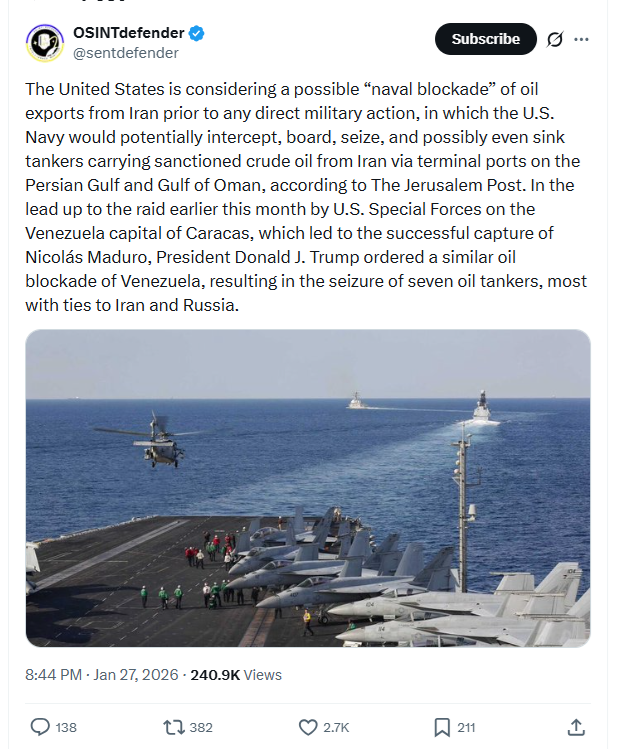
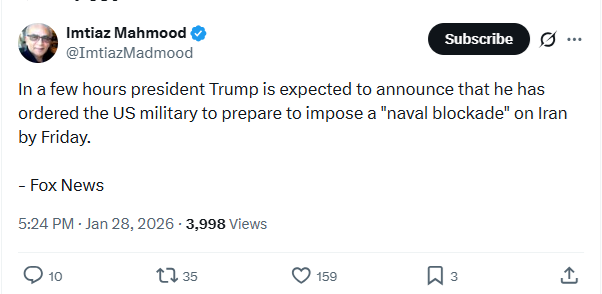
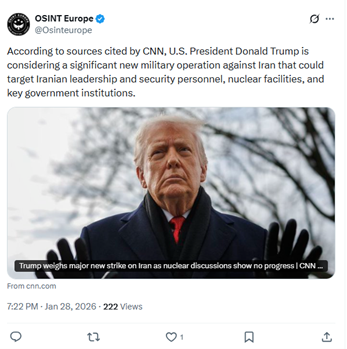
After a blockade would come a serious attack aimed at taking out senior leaders, the nuclear program, and other key military assets.
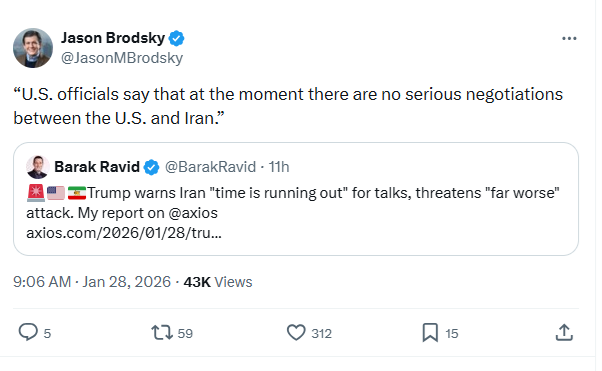
Axios is reporting that there are no serious talks going on between the two nations, so the chances of a diplomatic offramp in the near future are basically zero.
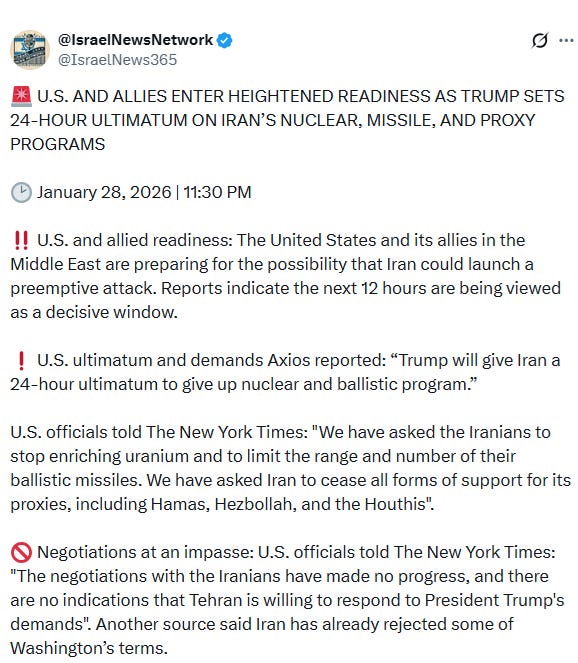
Trump reportedly asked for Iran to stop its nuclear and ballistic program and gave a 24 hour deadline. He also asked for them to withdraw support from groups like Hizballah and the Houthis. He must know that Iran has spent decades on these efforts, and giving them up on such a tight deadline with no US concessions is a non-starter.
To recap then we have:
A blockade coming in the next week
Zero real diplomacy and initial conditions that are unacceptable to Iran
A detailed plan already formed to attack Iran for several weeks, and a target list is being finalized
We still think war is coming. Likely in the second half of February or early March once all of the US assets in place and Iran continues to refuse to negotiate.
The aircraft carrier Abraham Lincoln is already in place off of Iran. The George Bush is headed there as we write. There are rumors that the Theodore Roosevelt will soon join as a third carrier in the region.
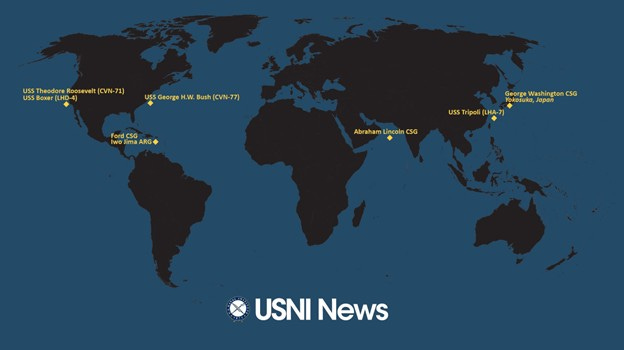
USNI, Jan 26th
2) Cuba Regime Change This Year?
With regime change in Venezuela now complete, the last stop in consolidating the Western Hemisphere is Cuba. It’s a communist country and a US enemy since the 1960’s. But the country has been hit hard over the past twenty years by a terrible economy, political repression, and constant emigration to the US. It has strengthened ties with China and Venezuela in a bid to survive.
The US government has ordered Venezuela to stop oil exports to Cuba. With its only supplier cut off, it’s only a matter of time before the economy grinds to a halt. The US has put pressure on other allies like Mexico not to sell to Cuba or face sanctions.
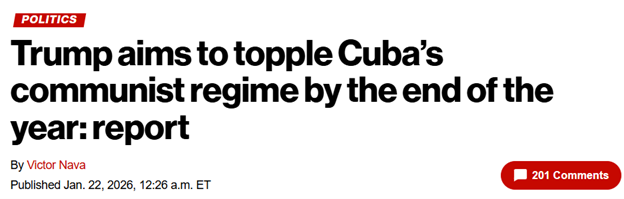
The goal is a regime change this year:
- New York Post
The US is looking for domestic political allies to take up the baton in Cuba. The target is by the end of the year to force change. While Cuba is a police state too, the leadership is on borrowed time if the economy continues to implode. Look for some more constructive headlines on this by year end.
3) The New Regime in Venezuela
The operation to remove Maduro occurred on January 3rd. Since then, the VP Delcy Rodriguez has been at the helm but taking orders from the US. What is the US plan with her?
First off, she is making decisions with a metaphorical gun to her head. After the capture of Maduro, she was told she had fifteen minutes to agree to work with the US or face a similar fate.
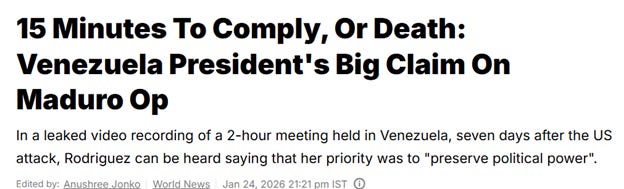
-NDTV
The US is working with her because she has some power over the military and police unlike democratic leader Maria Machado. If she doesn’t comply, the US has said repeatedly that she is expendable. The Maduro raid thought we think is going to be a powerful bit of persuasion for political leaders in Venezuela.
A recent Politico article did a good job of giving us the roadmap from here. Marco Rubio testified in Congress and also gave some indications of the administration’s priorities over the next year or two.
Number one is to end the drug smuggling and the foreign influence of China, Russia, Hizballah and other groups:
[the U.S.] “will set the condition so that we no longer have in our hemisphere a Venezuela that’s the crossroads for many of our adversaries around the world, including Iran and Hezbollah, is no longer sending us drug gangs, is no longer sending us drug boats, is no longer a narcotrafficking paradise.”
Related to that is cutting off oil exports to China and other US enemies like Cuba. That should help catalyze regime change in the latter.
The second priority seems to be to set a timetable for free and fair elections. That is indeterminate as of now. Much work will have to be done to prepare the system to hold such an election. But as of now Rodriguez is the only one able to make necessary changes.
The focus from here is also going to be releasing the thousands of political prisoners imprisoned under Chavez and Maduro in a steady stream.
Sanctions and credit restructuring would likely follow a free and fair election. The US had discussed dropping sanctions immediately, but apparently there had been no inter-agency plan created to do that smoothly.
It’s going to be a long road but the outlook is bright for Venezuela. After 25 years of socialism and authoritarianism, the country finally has a realistic roadmap to something better. In two or thee years, we could have a stable and democratically elected government. That would be accompanied by the end of hyperinflation, a debt restructuring and the end of sanctions. This would create a powerful tailwind for the country for the next decade or two.
4) New Brazil Poll Shows Bolsonaro Ahead
Last week, the first poll by Apex should a hypothetical second round between current President Lula and challenger Flavio Bolsonaro, son of former President Jair Bolsonaro. It showed a six point Bolsonaro lead, the first time yet, and a big boost over the initial polls showing him down by 6 to 10 points.
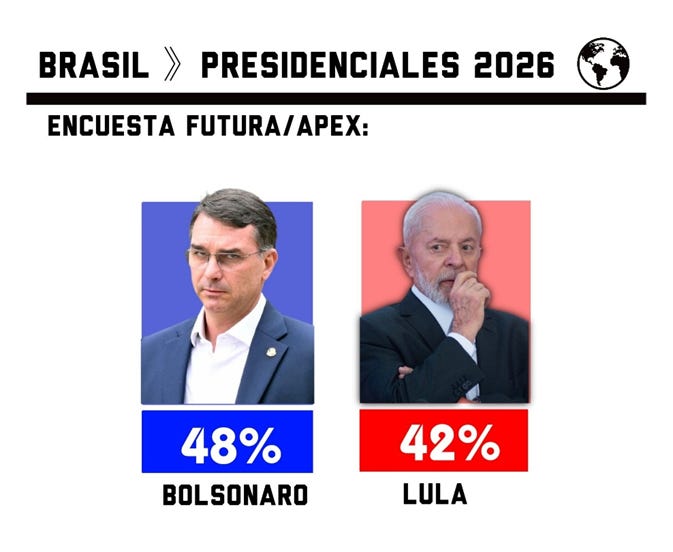
Now, let’s remember, it’s just one poll. The election is nine months off. But, if this is an accurate reading of the electorate, it shows that the right can win this year in Brazil. That would catalyze a huge second half rally in the market. EWZ, the Brazil ETF, is already off to a great start (+15% YTD) on the back of commodities.
5) The Fed Pauses – Next Stop, A Hike?
The Fed met on January 28th and decided to keep rates unchanged. They did three rate cuts last year as a preventive measure, citing the deterioration in labor conditions. They saw these as insurance cuts to make sure unemployment didn’t spike.
At the press conference today, Powell mentioned essentially that the labor market had stabilized and looked okay. The much lower immigration numbers (only +300,000, whereas America was accepting net 2 or 3m per year under Biden) means of course that job growth is going to be slower, a fact they are comfortable with.
They mentioned also that inflation continues to run above their 2% target- for the fifth year in a row. It was apparently a contentious meeting, with dissents calling for a 25bps or 50bps cut.
Given the rise in all commodity prices, we think the risks for rates now lie to the upside. That may surprise people, but if one looks at the underlying inflation picture it’s still running high. Headline and core PCE, the Fed’s preferred measure are both running at 2.8%, versus the Fed’s 2% target. Both have risen 30bps in the last nine months. The rise in all commodities, from oil to natural gas to silver and copper, is going to put fresh pressure on the goods part of the inflation indices. If that pressure continues, especially if there is higher energy on the back of a conflict with Iran, then it’s not hard to see 3.5% inflation in the second half of year and a Fed that begins to slowly hike to counter it.
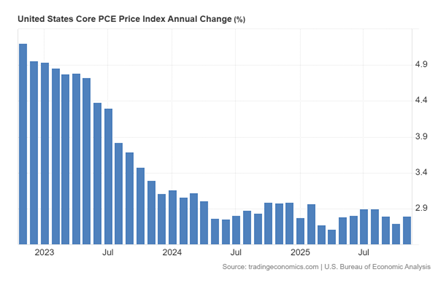
If Trump appoints a new Fed chairman who then follows through on his goal to lower rates we would be wrong, obviously. But that Fed chair does not have unliateral control, he would have to get the committee on board. But that would cause a huge selloff in long end rates and steepening in the yield curve as the Fed gets further and further away from sustainable 2% inflation.