Latam Politics Update
Colombia, Brazil, Venezuela, Argentina, Cuba

Email: decodingpolitics@protonmail.com
Substack: decodingpolitics.substack.com
Twitter: twitter.com/DecodingPoliti2
*Not financial advice, merely pointing out political and macro trends*
We are going to give a quick tour of the region at this politically important time with a lot happening in the region. We lead with one money making opportunity and then follow with the politically important news in four other countries.
In Colombia, we see a likelihood of a swing back to right wing politics in the country. This seems to be underappreciated in the markets at the moment. We anticipate the markets could have a surprise rally after the election.
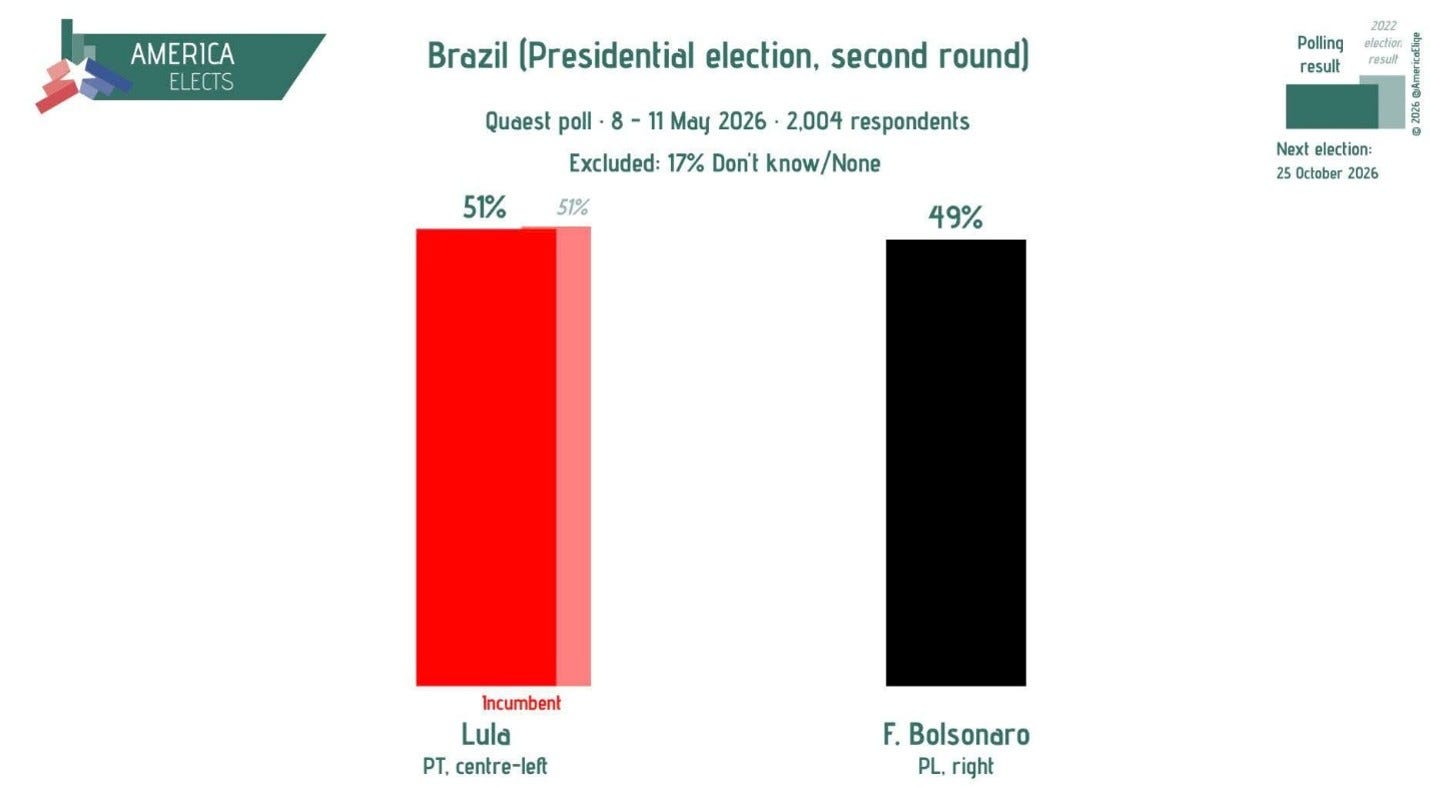
Brazil has an election coming up in October. Lula continues to lead the polls, which has accounted for recent weak trading. The market will be cautious unless Bolsonaro takes the lead.
In Argentina the macro story continues to be 10/10. But there is still micro pain and it’s hurting Milei politically. Can he turn it around in the next year to win reelection?
Venezuela has done massive reform and is rapidly attracting US investment. We go through all the changes.
Cuba is seeing protests and the head of the CIA recently visited and offered an olive branch. This looks like the beginning of the end of communism. Within a year, it should begin to follow the Venezuela path and rapidly open up economically and politically.
Colombia
Colombia goes to the polls on May 31st. Unpopular current President Gustavo Petro cannot run again. His party picked left wing activist Ivan Cepeda as his successor. On the right, there is avowed Bukele fan Alberto Espriella and more center right Paloma Valiencia. The country requires a majority to win, and it looks no candidate will have a majority in the first round. It’s highly likely it goes to a run-off. At this point it looks like either right wing candidate has a few point advantage over the left wing candidate Cepeda that second round. But if we add the votes for the two right wing candidates, not taking out the undecided non responders, they are comfortably at 51% total. That goes to 54% adjusting for those non responders.
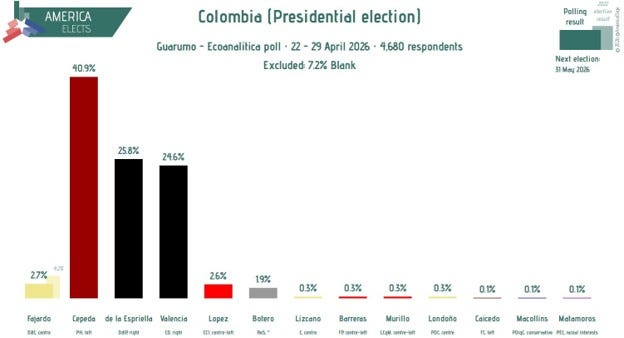
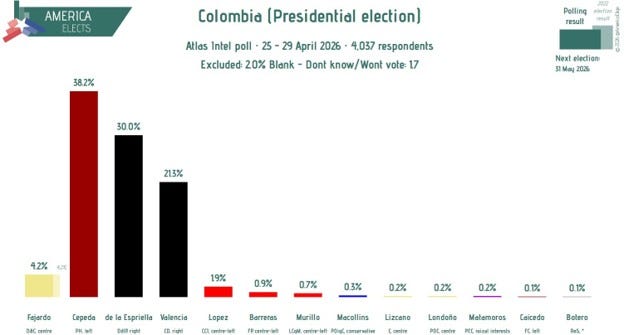
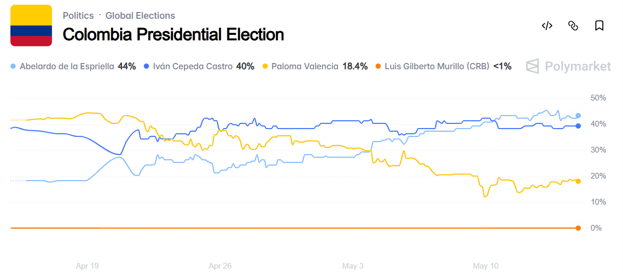
Polymarket now has Espriella ahead, but the markets are not discounting that yet.
Despite the rise in oil prices, the Colombian peso has fallen five percent in the past few months on election jitters (higher here means weaker peso, stronger dollar).
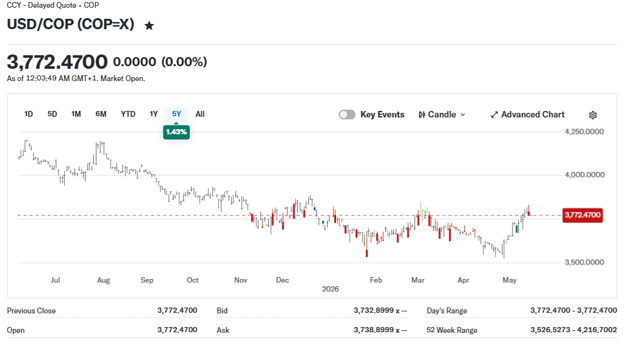
We think there could be a surprise move higher here after the elections as investors on the sidelines realize a market friendly President will finally be coming into power.
Brazil
Brazil goes to the polls on October 5th. There had been several polls showing a tie or Bolsonaro ahead in the past few weeks. But a recent one showed Lula back in the lead.
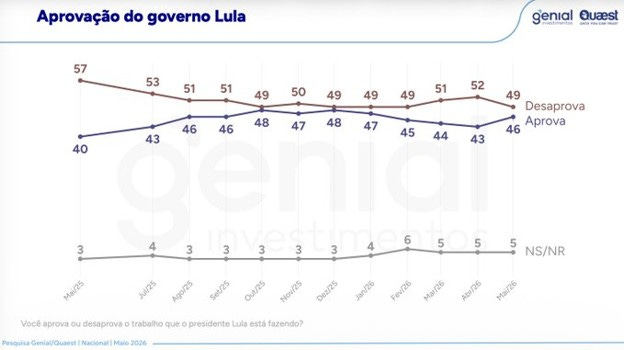
Simultaneously, Lula’s approval has ticked up from 43% to 46%
This has put pressure on the Brazilian equity market. Despite the global rally, EWZ is down 11% in the past month.
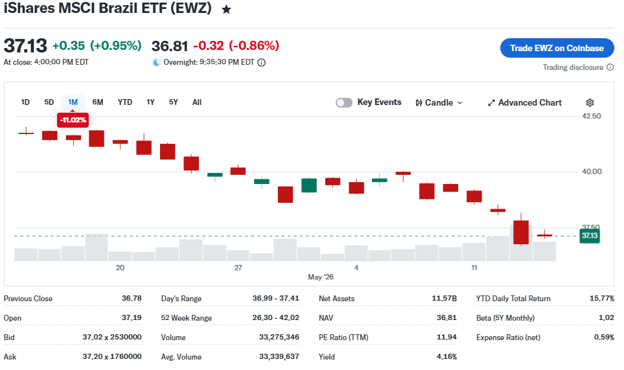
Expect the market to continue to underperform as long as investors continue to worry that another four years of Lula is on the horizon. We think that higher inflation into October could again pressure Lula’s popularity and make this very tight.
We anticipate that if polling continues to deteriorate, we may not see an entry point for a while. If the polling swings back, then there could be a great entry point in September into the election.
Argentina
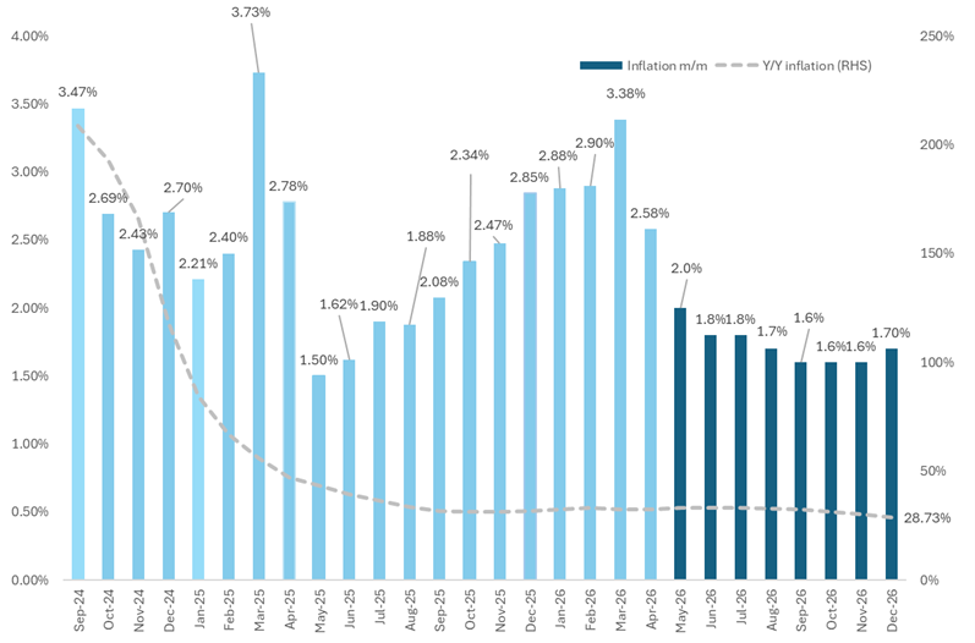
The macro story in Argentina continues to be excellent. The country spread is now at the lowest level in eight years. The government was able to issue dollar debt locally. Monthly inflation has fallen to the 2.6% level, or around 30% annualized. That compares to 300% when Milei entered office. Forecasts have it going sub 2% mom and to roughly 20% yoy by year end (from BTG pactual)
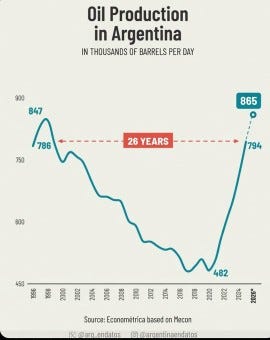
The country’s oil production has grown rapidly with the expansion of Vaca Muerta and the country is now a net energy exporter.
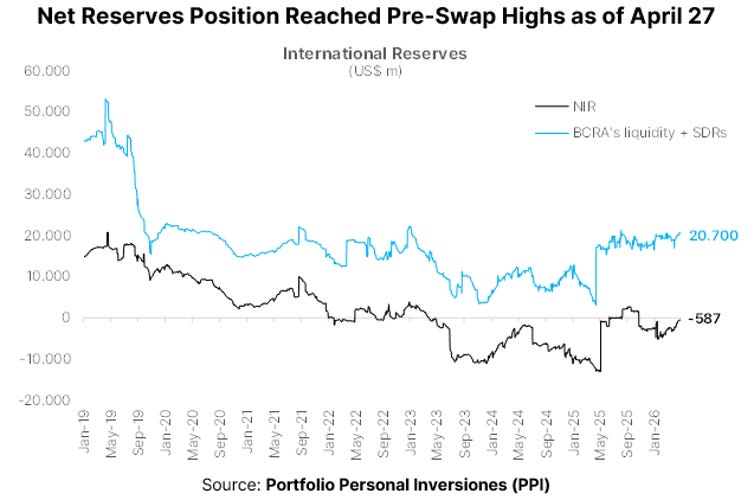
The country continues to accumulate reserves for the first time in years and has paid back the US swap line.
Yet the cost of success in this macro adjustment has been slow growth and a problem of affordability for the average person. That average person had had subsidized gas and electricity for over a decade, and a cushy union job. All of that is now gone and the squeeze is intense. It will take time before all the money and investment flooding into the country raises real incomes and the cost of living comes down.
As a result, Milei’s approval is in the tank at the moment, the lowest of his Presidency.

At this point, we have to balance the macro and the eventual recovery with the political implications. Given that we have 14 months until the Presidential election in October 2027, that’s enough time to turn around with lower inflation and improving growth. Macro variables like inflation and country spread typically lead approval ratings- and they are improving. Ronald Reagan had a similar tough adjustment and double dip recession in late 1980/1 and then in 1982, but turned around with a major victory in 1984. We still love the structural Argentina story despite the speed bumps.
Venezuela
The US removed former President Nicolas Maduro in spectacular fashion at the start of the year. They gave VP Delcy Rodriguez a battlefield promotion and warned her that if she didn’t follow the US agenda she faced the same fate. The US and Venezuelan government have moved quickly since then. They have implemented a comprehensive reform agenda and are already beginning to attract business back to the country.
The first step was to reform the oil industry and attract foreign operators back to the country. Venezuela’s oil industry is controlled by the government and its state-owned oil company, PDVSA, which has control of every project and a majority stake.
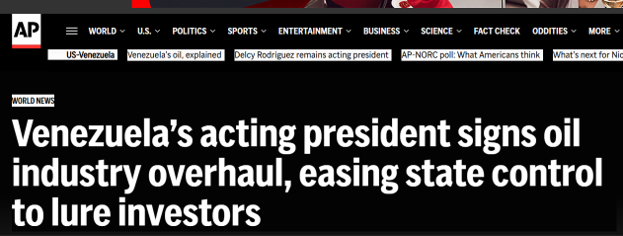
This bill would:
· Allow private operators to operate free from PDVSA partnership, provided their plan was approved by the ministry
· Allow arbitration instead of all disputes going through a Venezuelan court
· Cap extraction royalty rates at 30%
In return, the US is lifting sanctions on Venezuelan oil and restrictions on US operators in the country. Already several major projects have been announced.
The government has done something similar in the mining industry. Venezuela has huge gold and rare earth reserves to exploit.
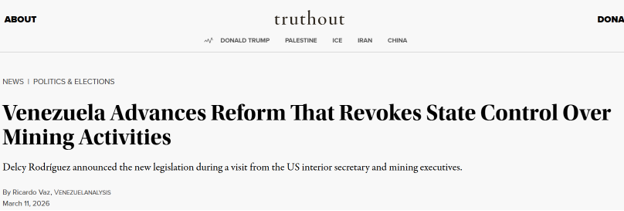
“Concerning mining activities, the proposed law establishes that joint ventures, private corporations, and small-scale artisanal mining groups are allowed to receive concessions. The new law will replace a 2015 decree that imposed state control over mining exploration, as well as the 1999 Mining Law.”
Already several companies that were kicked out are returning to the country to mine.
Then there are general reforms on competitiveness. These will roll back onerous Chavez/Maduro era restrictions on business.
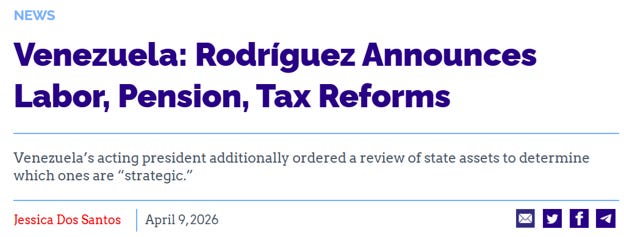
Venezuelanalysis
The US for its part is beginning to lift sanctions in a sequential fashion.
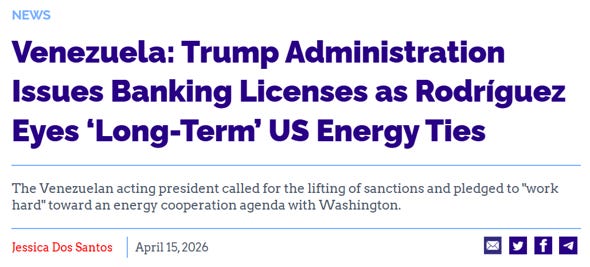
Venezuelanalysis
This will allow US banks now to transact with the central bank and publicly owned banks in Venezuela. It will allow US operators to be able to move money in and out of the country. The full return of Venezuela to SWIFT, opening up of USD accounts in Venezuela, and lifting of all sanctions is several months away but is in progress. The heavy sanctions since 2019 look to be going away by this time next year. That will allow real banking, credit intermediation, and foreign investment over the coming years.
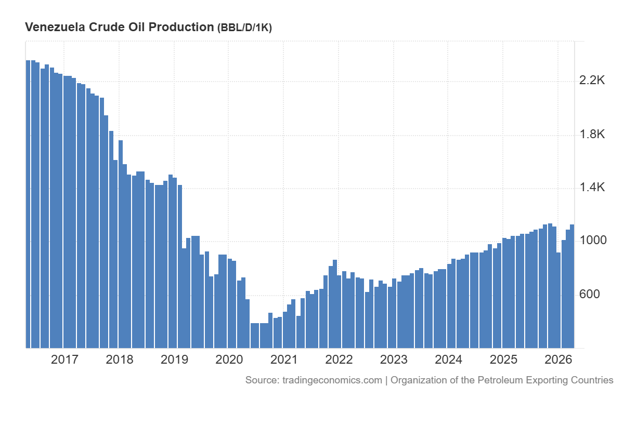
The most crucial task for the country after passing all these laws is to get oil revenue up. The much higher oil prices due to the Iran war is helping. But oil production continues to recover from its giant fall a decade ago, and is now back to 1.13m bpd. Production was almost 4m bpd fifteen years ago.
Private sector credit has been wiped out by hyperinflation and sanctions. There is a huge runway for this in the coming years.
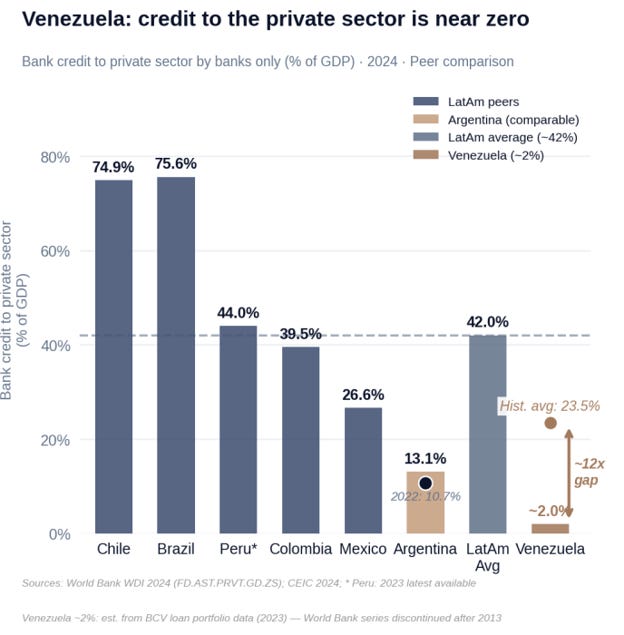
The timing of elections remains uncertain but that is the end goal of US political reform here. But tackling the country’s high poverty rates and broken private sector are the more pressing needs. Venezuela is finally opening up to the rest of the world after twenty five years of closing the door.
Cuba
Since taking out Venezuela, Cuba’s primary oil supplier, that country has been experiencing energy shortages. The US followed up with a full oil embargo and threatened to sanction any country selling them oi, such as Mexico. As a result, Cuba has run out of all energy and is now experiencing the worst blackouts in decades. There seems to be no reprieve in sight.
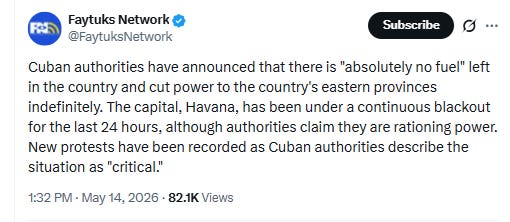
While the rest of the US government was in China, CIA director John Ratcliffe went down to Cuba carrying a message. It was essentially an offer of humanitarian support, but only if they started to open up Venezuela or 1991 Eastern Bloc/USSR style. The US is offering $100m of humanitarian aid immediately to Cuba. But they will do it via third party NGO’s and not just cut a check to the Cuban government.
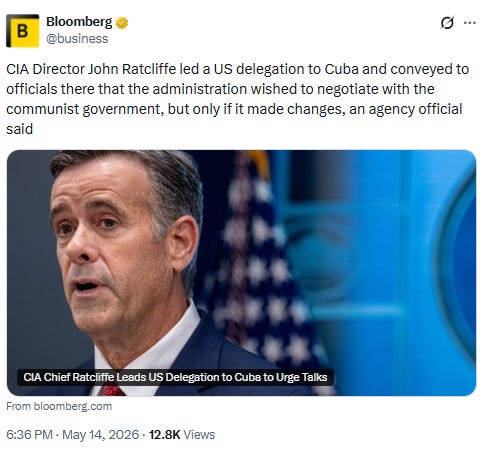
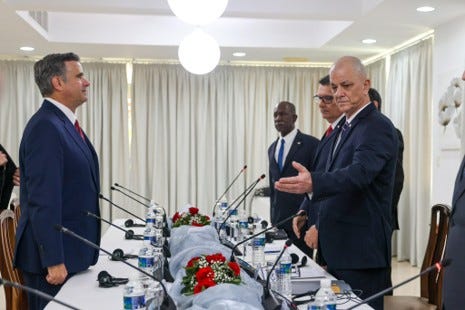
Reading between the lines, the US government is essentially offering to ease up if the Cuban government begins to go China-under-Deng Xiaoping style, and open up its economy rapidly and radically. Political opening would come soon after. Kicking out what remains of Russian and Chinese spying operations will occur quickly. The implicit threat for Cuban leaders is a repeat of Maduro in Venezuela: If you won’t do it, we’ll extract you and find someone else who will. That’s a powerful carrot and stick approach to bring on starving, blacked out Cuba at this point. The leadership simply has no choice but to accept right now or the people will hang them in six months anyway.
The Cubans apparently responded to this offer of humanitarian aid with the line: “It will encounter no obstacles or ingratitude.” Translation: We know it’s over, thanks for the food.
Historians will look back on this as the day communism began to end. The regime has zero options at this point. Their long-time regional ally, Venezuela, is now under full US control. They have zero oil and zero prospect of getting any in the near term. Their historical ally partners, Russia and China, are nowhere to be found. The US has the assets to invade them soon if they choose that route to force the matter. And popular support for the Cuban government seems to be approaching zero.
Recently investigative Youtubers, like Nic Shirley, have visited the country. He spoke to one person whose ration book had only permitted one egg per year, and one chicken per three years. They see how well their relatives in Florida live. Add in blackouts, internet cutoffs, and you can imagine how angry the population is. They would have done something about it a long time ago if not for the highly repressive state police.
The USSR was established in 1922 and dissolved in 1991. It lasted 69 years despite being the most repressive government perhaps in human history. Fidel took over in 1959, and Cuba has now reached 67 years of communism. It seems that communism wherever and however it is practiced has a maximum lifespan of 70 years. We can start writing out the death certificate now, thankfully, although we don’t know exactly how things will play out in the next few months.