
Email: decodingpolitics@protonmail.com
Substack: decodingpolitics.substack.com
Twitter: twitter.com/DecodingPoliti2
*Not financial advice, merely pointing out political and macro trends*
We have published and republished a piece on how we see the current AI driven market as comparable to the 2000 telecom/dot-com bust. Now we are going to drill into by far the most vulnerable player in the AI universe, OpenAI. We have found numerous red flags in looking at this. Not just direct shareholders should pay attention. Anyone invested in the tech/AI universe should learn more to see the risks to the other players in the industry.
We are not tech or AI experts by any means, we acknowledge. But we have been around the markets for over two decades and seen this kind of situation many times. No matter the industry or country, if you are heavily reliant on external funding you can only scale so big and so long before you have to show results – or the music stops.
We think the OpenAI boombox is about to stop playing. There are a host of problems, both qualitative and quantitative here. They are leading to the external funding environment closing in on them. We think that the problems will all be exposed around the time they make their prospectus to IPO (officially an S-1 filing) available to investors. The flameout will be comparable to WeWork, where no amount of made-up metrics and massaged financials could disguise the fact that it was not a sustainable business. That company went from being a few weeks from IPO in 2019 to a laughingstock months later. We are not saying OpenAI goes bust. But we think the hyper-spending, growth, and valuation will all have to be reset to much more rational levels. The constant high level departures and CEO Sam Altman’s very questionable past only add uncertainty to the mix.
We think that OpenAI’s impending financial restructuring and publicly bad headlines will hurt confidence across the space. The closer the partnership, the bigger the hit to the stock. Do some work and get prepared.

In the past two months, Decoding Politics has written in depth about the Iran war, US politics, the gold market and the BRICS’ influence on it, Canada, Brazil, the UK, and the US tech sector. Where else do you get such breadth and depth?
1. OpenAI Overview
2. Problem- Valuation Is Demanding
3. Problem- No Operating Leverage
4. Problem- Token Costs Under Pressure, Market Share Down
5. Problem- Debt Costs Rising
6. Problem- Mysterious Circular Financing
7. Problem- Heavily Reliant on External Funding
8. Problem- Management Departures
9. Problem- Altman’s Troubling Past
10. Likely Timeline of Events
1. OpenAI Overview

ChatGPT Logo
Open AI is an American AI company led by founder Sam Altman. It was founded in 2015 as a non-profit foundation to ensure safe and ethical development of AI models. It raised $221m in funding from the likes of Amazon, Infosys, Elon Musk, and Peter Thiel.
In 2025, it went fully for profit, with the foundation owning part of the company. It has aggressively grown in the past three years to become one of the largest AI companies in the world. Its premier product, ChatGPT, has over 1 billion users worldwide.
The company is now targeting an IPO of $1tn or more in the next twelve months.
We don’t think that happens. We think that the math and the story don’t make sense for the enormous amount of capital this company will have to raise. As investors get more information, they will ask more questions and tighten the screws. The spending is going to keep rising, but if investors don’t agree to fund it, then all sorts of problem will ensue.
2. Problem – Valuation Is Demanding
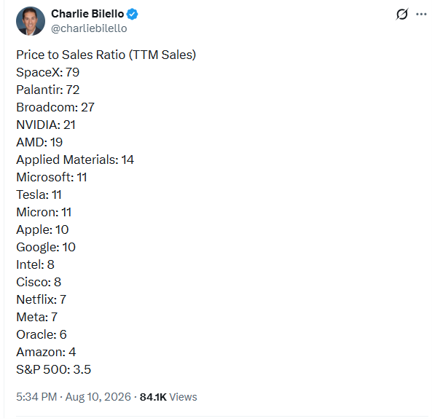
In March 2026, Open AI disclosed that its revenue was about $2bn per month, or a $25bn annual run rate. Let’s assume it’s now going to reach $40bn annual run rate at the end of the year. The last funding round was at $852bn and the company wants an IPO of one trillion or more.
That would make its valuation on 2027 revenue estimates at least 25x forward sales. Perhaps more if they juice the IPO price or seek to raise a bunch of money in the offering. That compares unfavorably with the many publicly traded companies that are profitable, not burning dilutive capital, and also riding the AI boom:
If you want meteoric revenue growth at a ~$1tn market cap, just buy Anthropic instead:
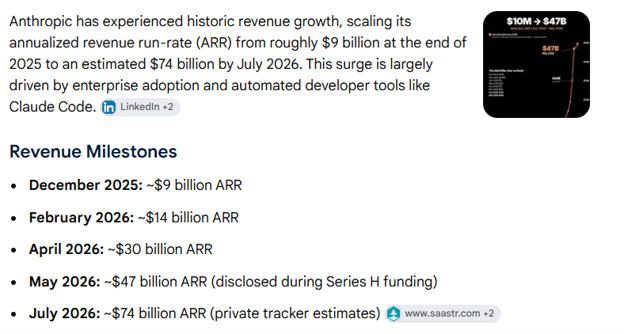
Source: Google Gemini
The valuation by itself is not a problem- not if the growth can make up for it (as seems to be happening at Anthropic), or if the profitability eventually emerges to benefit shareholders’ high expectations. But for reasons we will go into, we think neither will happen.
